Leaverage ETFs - The Good, The Bad, The Ugly - And How To Maximize Profits
Jun 09, 2026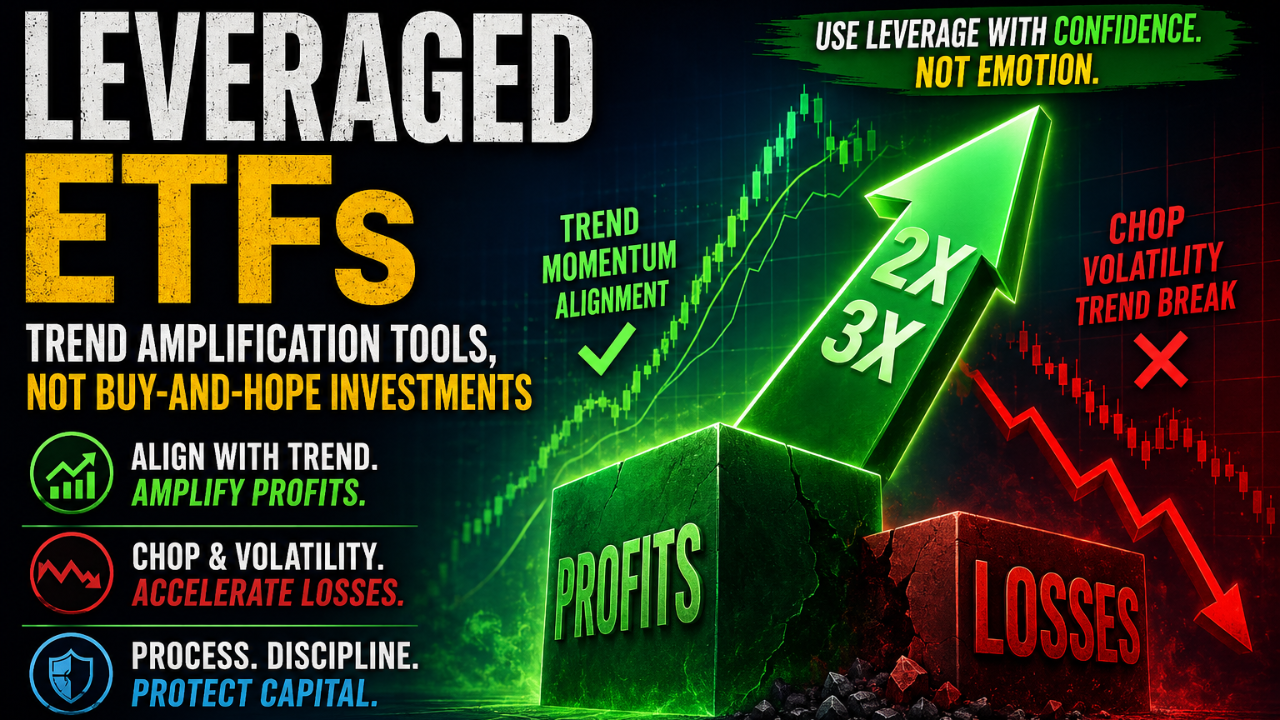
Leveraged ETFs: Trend Amplification Tools, Not Buy-and-Hope Investments
Leveraged ETFs can be powerful tools when used correctly, but they are also misunderstood by many investors and traders. Most of the warnings around leveraged ETFs are valid, but the real issue is not simply that leveraged ETFs are “bad.” The issue is that they are often used in the wrong market environment, with the wrong expectations, and without a clear exit plan.
Inside the Predictive Trader process, we do not view leveraged ETFs as long-term buy-and-hold investments. We view them as trend-amplification tools.
When the market is aligned, leveraged ETFs can accelerate returns. When the market turns against you, or when price action becomes choppy and volatile, they can accelerate damage.
The Main Idea
A leveraged ETF is designed to multiply the daily movement of an index or sector. For example, a 2x ETF seeks to move approximately two times the daily move of the underlying index. A 3x ETF seeks to move approximately three times the daily move.
That leverage can work beautifully when the market is moving in your favor.
If the market is in a clean bullish trend, and trend, momentum, and price action are aligned, a bullish leveraged ETF can produce strong gains. This is why leveraged ETFs can make sense inside a disciplined trend-following system.
However, leverage cuts both ways.
If the market turns against the position and you stay too long, losses can build quickly. A small decline in the underlying index can become a much larger decline in the leveraged ETF. This is where many investors get into trouble. They treat a leveraged ETF like a normal ETF, average down, and hope the position comes back.
That is not how leveraged ETFs should be used.
The Hidden Risk: Choppy Markets
The biggest mistake traders make is thinking leveraged ETFs only lose money when the market moves against them. That is not completely true.
Leveraged ETFs can also lose value or underperform when the market moves sideways in a volatile, back-and-forth pattern.
This happens because most leveraged ETFs reset daily. They are designed to deliver a multiple of the daily move, not necessarily a perfect multiple of the total move over several weeks or months.
For example, imagine an index starts at 100.
Day 1: The index rises 10%, moving from 100 to 110.
Day 2: The index falls 9.09%, moving back from 110 to 100.
The index is now flat.
But a 3x leveraged ETF would not be flat.
Day 1: It rises approximately 30%, moving from 100 to 130.
Day 2: It falls approximately 27.27%, moving from 130 to about 94.55.
The index returned to where it started, but the leveraged ETF lost value.
This is why chop is dangerous. The underlying market can go nowhere, while the leveraged ETF slowly gets damaged by volatility and daily compounding.
When Leveraged ETFs Work Best
Leveraged ETFs work best when the market is in a clean directional trend.
The ideal environment includes:
- Trend alignment across the major timeframes.
- Momentum expanding in the direction of the trade.
- Price action confirming strength.
- Low-to-moderate volatility.
- Clean breakouts, higher highs, higher lows, or confirmed trend continuation.
- A defined exit rule before entering the position.
This is where the Predictive Trader process becomes important. We are not buying leveraged ETFs because we are guessing. We are using trend, momentum, and price action to determine whether the market environment supports the use of leverage.
In other words, the tool is only as good as the process behind it.
When Leveraged ETFs Should Be Avoided
Leveraged ETFs should be avoided or reduced when the market shifts into a poor environment.
This includes:
- Sideways chop.
- High-volatility back-and-forth movement.
- Failed breakouts.
- Loss of momentum.
- Major support breaks.
- Distribution patterns.
- Trend reversal warnings.
- Periods where the indexes are no longer aligned.
The danger is not just being wrong. The danger is staying leveraged after the market stops trending.
A leveraged ETF can be useful during market expansion, but it can become very dangerous during compression, chop, or reversal.
Position Sizing Matters
A leveraged ETF should not be sized the same way as a normal ETF.
For example, if you place 10% of an account into a 3x leveraged ETF, that position acts more like 30% exposure to the underlying index. That means the position size must reflect the added risk.
The mistake is treating a 3x ETF like SPY, QQQ, or a traditional index fund. It is not the same. It is a trading vehicle with built-in leverage.
Because of this, position size should be smaller, exits should be clear, and the position should be monitored more closely.
The Predictive Trader Rule
Inside Predictive Trader, the question is not:
“Can I hold a leveraged ETF?”
The better question is:
“Is the market trending cleanly enough to justify holding daily leverage?”
That is the real decision.
Leveraged ETFs are not automatically good or bad. They are tools. In the right environment, they can help amplify gains. In the wrong environment, they can quickly destroy gains and damage principal.
The key is discipline.
Use leveraged ETFs only when the market is aligned.
Reduce exposure when momentum weakens.
Exit when the trend breaks.
Avoid holding through chop just because you are hoping the market comes back.
Never let a leveraged ETF become a hope trade.
Final Thought
Leveraged ETFs are not buy-and-hope investments. They are trend-amplification tools.
When trend, momentum, and price action are aligned, they can be powerful. When the market turns or becomes choppy, they can quickly become dangerous.
The goal of Predictive Trader is to keep us on the right side of the market, use leverage only when the evidence supports it, and protect capital when the environment changes.
The power is not in the leveraged ETF itself.
The power is in the process.