Markets face a lost decade as 2000 dot-com bubble parallels
Mar 15, 2026
Are We Entering Another Lost Decade?
Why Smart Advisors Are Shifting from Passive Investing to Navigational Management
Every generation of investors eventually hears the same phrase:
“This time is different.”
History has shown that these four words are among the most dangerous in investing.
Twenty-six years ago this month, the dot-com bubble peaked in March 2000. At the time, valuations were stretched to historic levels. Technology stocks were soaring. And the narrative was that the internet had fundamentally changed everything.
Sound familiar?
The great thing is the AUM Navigator signaled October 2000 to rotate from growth to fixed income (money market)
Today, many analysts are drawing parallels between today’s market valuations and those seen during the peak of the 2000 technology bubble. Back then, the cyclically adjusted price-to-earnings ratio (CAPE) reached record levels — nearly three times the historical average.
What followed was a painful lesson for investors.
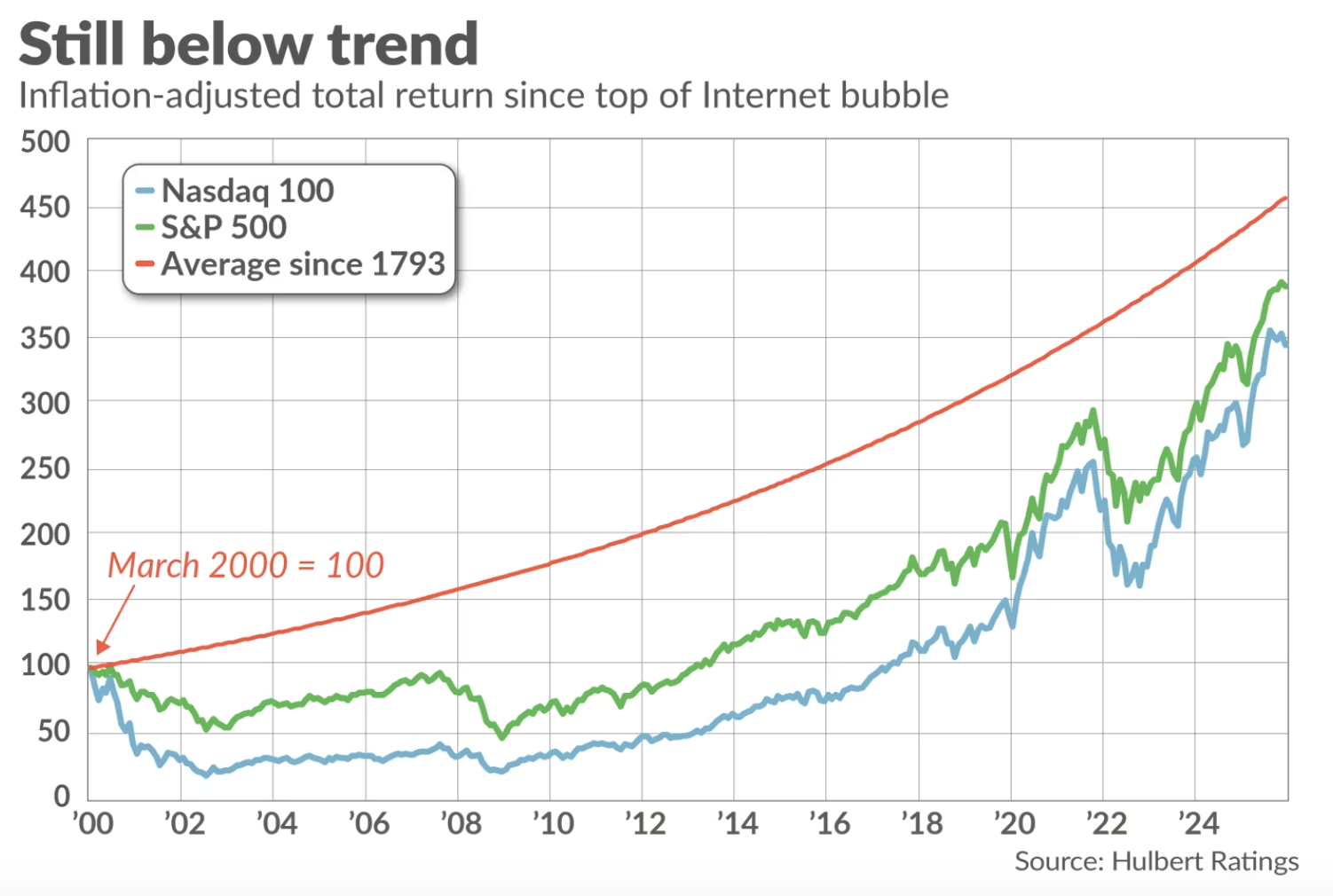
The Lost Decade That Many Investors Forget
After the internet bubble burst, the market did not simply bounce back.
In fact, the following decade produced negative real returns for U.S. equities.
From March 2000 to March 2010:
-
The S&P 500 delivered approximately –7% annualized real returns
-
The Nasdaq-100 lost over –10% annualized
For many investors, it became known as the “Lost Decade.”
And yet, during that period there were multiple rallies, sector rotations, and opportunities.
The problem wasn't the market.
The problem was the strategy investors were using.
Most portfolios were built on a buy-and-hold philosophy, leaving investors fully exposed to market cycles with no real plan for navigating major shifts.
Why Today’s Market Looks Uncomfortably Familiar
Fast forward to today.
Current valuations are once again approaching levels seen during the peak of the 2000 bubble.
At the same time, several warning signals are appearing beneath the surface:
• Market leadership is narrowing
• A handful of mega-cap technology stocks are carrying the index
• Only about 30% of stocks remain above their 50-day moving average
• The VIX fear index is rising, signaling growing investor concern
• Systematic funds may soon reduce exposure to equities
On the surface, the market appears stable.
Underneath, the structure is becoming fragile.
And history tells us that valuation extremes rarely resolve quickly.
The Real Problem Advisors Face
Most financial advisors today operate within a model that looks like this:
-
Gather assets
-
Allocate to third-party managers
-
Hope the market cooperates
This works extremely well during bull markets.
But when the environment changes, advisors often find themselves telling clients the same phrases:
• “Just hold on.”
• “It will come back.”
• “It's only a paper loss.”
I know this because I spent more than 15 years as a financial advisor myself.
The truth is this:
Advisors are responsible for the results — even when they outsource the decisions.
Clients don't care who made the mistake.
They simply want to know:
“Why didn’t we see this coming?”
The Shift Toward Navigational Management
The future of wealth management is not about predicting the market.
It’s about learning how to navigate it.
This is what we call Navigational Management.
Instead of relying purely on static portfolios, navigational advisors focus on three key elements:
1. Trend
Is the market environment supportive or deteriorating?
2. Momentum
Is money flowing into or out of major sectors and assets?
3. Price Structure
What is the market actually doing beneath the headlines?
When these elements are combined, advisors gain something powerful:
Context.
And context allows advisors to rotate capital, manage risk, and guide clients through changing market environments.
Why Advisor’s Edge Was Created
After selling my wealth management firm, I noticed a pattern.
Most advisors were excellent at:
• Building relationships
• Structuring insurance solutions
• Managing client expectations
But very few had a repeatable system for managing AUM through full market cycles.
That’s why we created Advisor’s Edge.
Advisor’s Edge trains financial professionals how to:
• Interpret market environments
• Communicate market conditions clearly to clients
• Coordinate third-party managers effectively
• Improve compliance and documentation
• Position portfolios ahead of major market shifts
We combine structured methodology, market indicators, and weekly coaching to help advisors become more than asset gatherers.
We train them to become true navigators of capital.
The Next Decade Will Reward Navigators
If history repeats itself — and valuations matter — the next decade may look very different from the last one.
Markets may become:
• More volatile
• More rotational
• Less forgiving for passive strategies
That environment will create two types of advisors:
The Passive Advisor
Explains what happened after it happens.
The Navigational Advisor
Sees the environment shifting and adjusts accordingly.
The difference between those two advisors can mean millions of dollars in preserved client wealth — and a massive difference in professional reputation.
The Bottom Line
Markets will always cycle between expansion and contraction.
Advisors can't control the market.
But they can control how they respond to it.
The advisors who thrive in the next decade will not be the ones who simply gather assets.
They will be the ones who understand how to navigate markets.
If you're a financial advisor who wants to strengthen your market leadership, improve client confidence, and better position your AUM through changing market cycles…
Take a closer look at Advisor’s Edge.
Inside the program, we provide:
• Weekly market navigation training
• Proven portfolio rotation frameworks
• Proprietary market indicators
• Live coaching and advisor community
Because in the next decade, navigation will matter more than prediction.
And the advisors who master it will stand apart.
Learn more about Advisor’s Edge here:
https://www.catalystwealthcoaching.com